Heritage Restoration
Ornamental Plastering
Jesmonite Casting
Wirral
Rebuilding a Victorian Entrance Porch — Larger, Grander, True to the Original
How we used fibreglass moulds, jesmonite casting, and stone with a remarkable history to recreate a period porch — at a grander scale than the one it replaced.

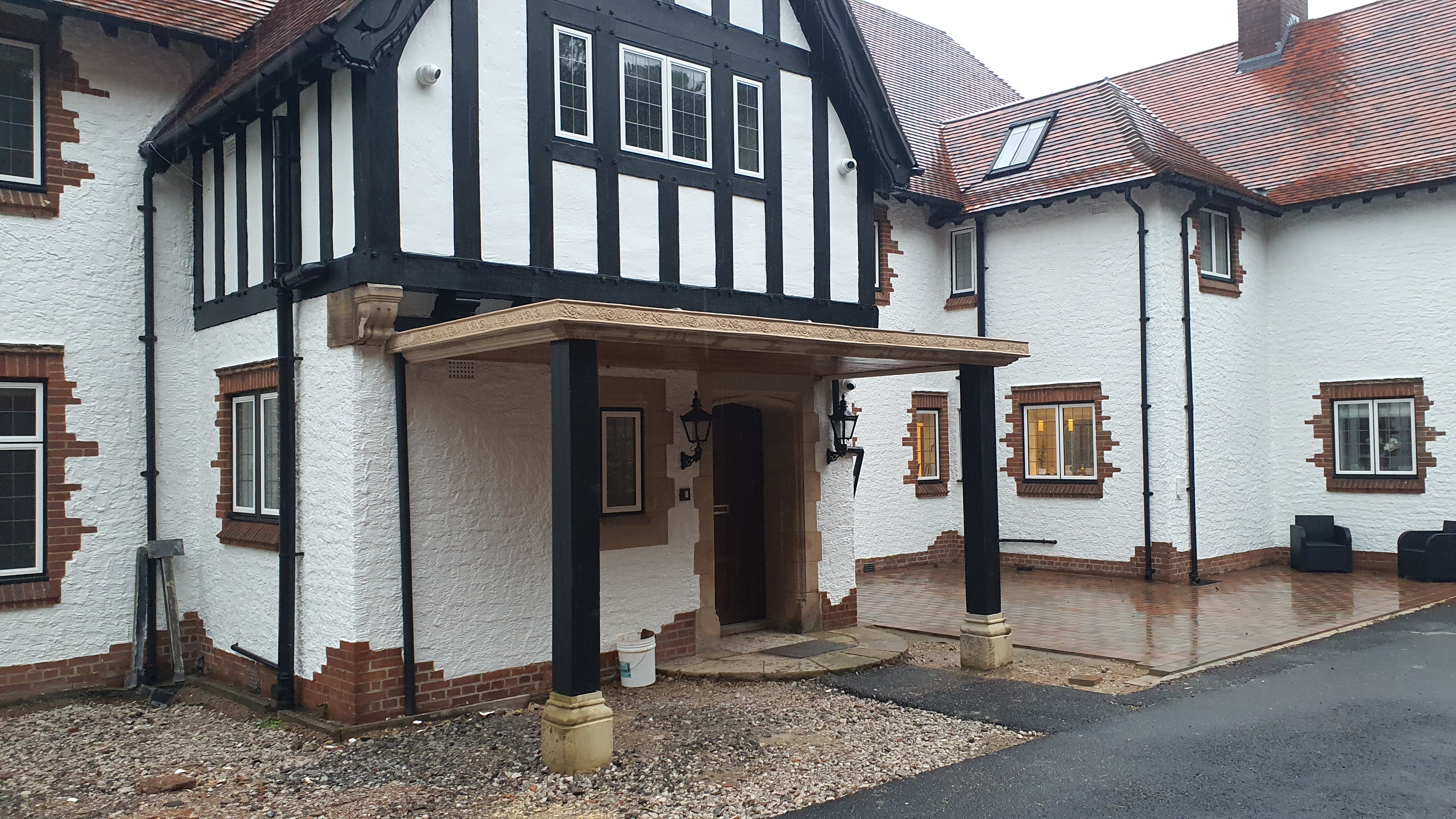
The completed porch — new jesmonite cornice edging with rose motif, sandstone column bases, and a steel-framed canopy finished in a warm natural sandstone colour.
When the owners of this substantial Arts & Crafts manor on the Wirral approached us, the brief was deceptively simple: the existing Victorian entrance porch needed replacing. But not just replacing — it needed to be enlarged to better suit the scale of the house, while retaining every inch of its ornate period character.
The house itself dates from around 1930, but the porch it carries may well be older — a survivor from an earlier structure on the same plot, or perhaps salvaged and re-erected when the present building went up. That ambiguity is part of its character. Whatever its precise origin, the craftsmanship it embodied was unmistakably Victorian, and it deserved to be honoured as such.
The site has a deeper history still. The house stands on land that formed part of the former Dawpool Estate, Thurstaston, once the seat of Thomas Henry Ismay — the founder of the White Star Line, and the man who commissioned the ships that would make maritime history. That legacy would prove unexpectedly relevant to the materials we chose.
The original porch featured beautiful decorative leadwork guttering embossed with a continuous running-rose motif and finely profiled wooden cornicing. Most of it was past saving. The timber was riddled with rot, the lead was failing, and structurally the whole canopy needed to come down. What it left behind, though, was a perfect template.
“The ornate lead guttering had taken craftsmen hours to produce. Our job was to honour that work — and make the new version last another hundred years.”
Documenting the original before demolition
Before a single bolt was loosened, we photographed and measured every element in detail. The original lead cornice was particularly important — its repeating rose-and-leaf relief was the defining decorative feature of the porch, running along all three exposed faces of the canopy edge.


The original leadwork guttering still in place — heavily weathered but the rose-and-leaf relief pattern remained sharp enough to mould from directly.
The leadwork was in poor condition cosmetically, but once straightened was structurally sound enough for us to take fibreglass moulds directly from it. This gave us an exact negative of every undulation, every petal, every stem — so that our cast reproductions would be indistinguishable from the originals in profile and texture.
Casting the cornice in jesmonite
With accurate fibreglass moulds in hand, we cast the new decorative cornice sections in jesmonite — a water-based acrylic composite that takes fine detail superbly, sets hard, and is fully weatherproof. We coloured the mix to match the warm yellow-buff of natural Cheshire sandstone, tying it visually to the new column bases being carved simultaneously in the workshop.

Workshop comparison: the newly cast jesmonite cornice section (foreground, in sandstone colour) alongside one of the original black-painted lead sections. The rose motif transferred faithfully from the fibreglass mould.
Each section was cast in manageable lengths to allow handling and installation, then trimmed and finished by hand. The material can be worked with stone cutting tools — vital for achieving tight mitred joins at the corners of the canopy.

The new column capital bases hand carved before installation.
Stone with a remarkable history — reclaimed from Harland and Wolff, Regent Road, Liverpool
The column bases posed a different challenge entirely. The original porch was gung from iron hangers, and matching new dressed sandstone to the warmth and texture of Victorian-era stone is notoriously difficult. The solution came from an unexpected — and rather extraordinary — source.

The Harland and Wolff Shipbuilding and Engineering Works, Regent Road, Liverpool — the source of our sandstone column bases. Note the demolition notices already posted on the facade. Photograph © Chris Iles Photography — chrisiles.co.uk
The blocks had been salvaged during demolition work and sat waiting for the right project. Being genuine Victorian-era sandstone quarried and dressed to the standards of the day, the colour, grain, and surface character were exactly what this porch demanded — warm, slightly textured, and unmistakably of the period.

The reclaimed Harland and Wolff sandstone blocks en route to the workshop — Victorian-era stone with an extraordinary history, and exactly the right colour and character for this project.
Our team hand-carved each base to the correct profile, working through a series of stepped plinths that echo classical column base proportions. The finished bases carry a weight and authenticity that cast alternatives simply cannot replicate — and a provenance that makes them genuinely one of a kind.

The finished column bases, hand-carved from reclaimed Harland and Wolff sandstone. The stacked plinth profile is faithful to the Victorian original — the material itself connects the porch to one of history’s most famous stories.
The structure: steel frame, hardwood posts
The enlarged porch required a structurally robust solution. A steel box frame was fabricated to carry the canopy load, bearing back into the masonry of the house. The freestanding supports are large-section hardwood posts chosen to give the porch the visual weight appropriate to its scale — and to the house behind it. The steel was then clad and finished so it reads as a traditional fascia from the outside.


Left: the telehandler was essential for positioning the heavy steel frame elements at height. Right: the canopy structure with temporary covering while the decorative elements were prepared off-site.
Before and after
The transformation is best appreciated side by side. The original porch was narrow and visually tentative — out of proportion with a house of this stature. The rebuilt version commands the entrance without dominating it, every ornamental detail restored and the scale finally matched to the building it serves.

Before
After
Before (left): the original porch with failing leadwork, damaged stonework, and rotten timber. After (right): the completed rebuild — wider footprint, all ornamental details faithfully reproduced in jesmonite, with column bases carved from genuinely historic sandstone.
01
Survey & mould
Fibreglass moulds taken directly from original lead guttering before removal
02
Cast in jesmonite
Cornice sections cast in sandstone-coloured jesmonite from the original moulds
03
Carved stone bases
Column bases hand-carved from reclaimed Harland and Wolff sandstone, Regent Road, Liverpool
04
Steel frame
steel box frame fabricated and lifted into position using telehandler
05
Install & finish
Decorative elements fixed, columns set, canopy completed and dressed
Projects like this sit at the intersection of traditional craft and modern materials science. Jesmonite gave us the fidelity of the original lead relief without the weight or the long-term maintenance burden. Reclaimed stone gave us authenticity that no reconstituted product could match. And a properly engineered steel frame means this porch will outlast the one it replaced by a considerable margin.
There is something fitting about a porch that may itself be older than the house it adorns — a Victorian relic re-erected on Edwardian or interwar foundations, on land that Thomas Ismay once walked, rebuilt with stone from the workshops of the company he founded. Every layer of this project reaches back into the same remarkable chapter of Merseyside history. Craft that endures, repurposed for craft that endures.

Leave a Reply